
 London School of Economics
Meeting great expectations; behaviour, emotion, and trust
A Jabra study at the London School of Economics’ Behavioural Lab on the impact of technology on people in modern meetings
There must be a better way to meet
How much is the technology we’re using impacting our behaviour in meetings and our ability to collaborate effectively?
In May 2023, Microsoft revealed that people are in 3x more meetings and calls per week at work, than they were in February 2020 – a 192% increase.1 The average worker spends about 25% of their day in Teams meetings. Given that there are over 572 million knowledge workers globally2, we’re collectively spending billions of hours in online meetings each week. And yet, many of those meetings are taking place in conditions that are far from conducive to collaboration or productivity.
Inefficient meetings are the leading barrier to productivity, according to Microsoft. At the same time, having too many meetings was ranked as the third biggest productivity disruptor.3 Earlier this year, in our Jabra Hybrid Ways of Working 2023 Global Report, we found that how people were seen and heard, as well as how well they could see and hear their colleagues in remote meetings was impacting team trust, creativity and innovation.
Although we’re collectively spending a significant portion of our time in online meetings and there are many calls for a return to office, most meeting rooms still don’t have the right equipment. All of this led us to wonder, how much is the technology we’re using impacting our behaviour in meetings and our ability to collaborate effectively?
Answering that question has taken over a year of work by Jabra at the London School of Economics’ Behavioural Lab, to try and understand the biopsychological impacts of the technology we use in our day-to-day work, and how it impacts our relationships, wellbeing, trust, emotions, and engagement in meetings. This first-of-its-kind behavioural research, in collaboration with the LSE, sheds new light on the subject, and offers some guidance on a better way to meet in a hybrid world.

The research at a glance
How much is the technology we’re using impacting our behaviour in meetings and our ability to collaborate effectively?
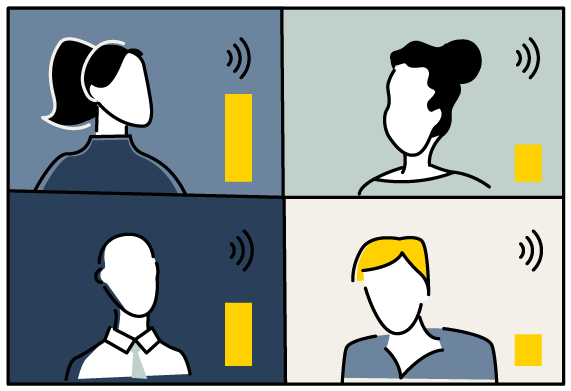
The research was conducted based on an eight-person hybrid virtual meeting group. With four of the participants sat together in the situational context of an in-room group, which was complimented by an additional four remote participants. The research utilizes a mixed format design centering around two key independent variables, situational context (remote or in-room) and the quality of the audio-visual experience (high quality using Jabra equipment, low quality using generic or competitor equipment).
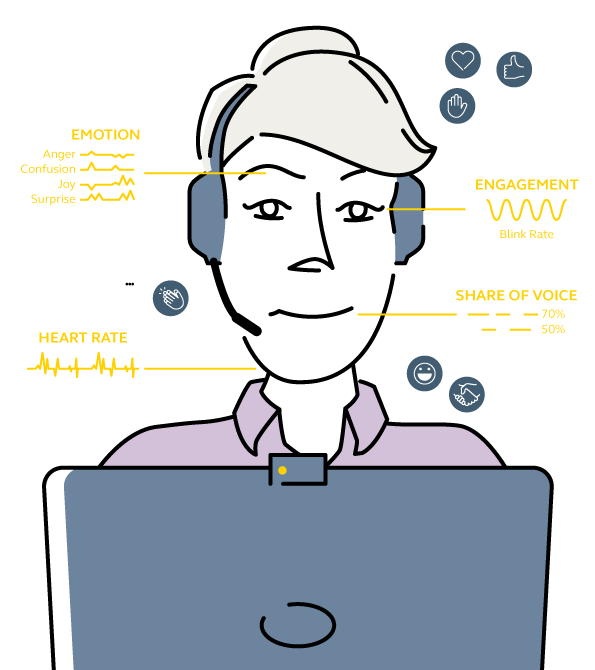
The study used a diverse range of psychological approaches and measures, ranging from self-report ratings to capture participants’ opinions and feeling, through to highly objective and sophisticated eye-tracking, facial-expression analysis and biological indices of arousal and cognitive load (skin conductance response and endogenous eye blink). Synchronizing and collating the vast amount of data produced was in itself demanding, with each participant producing close to 500 data points per second.

Who
Sean Rooney, Chief Scientific Officer and Head of Laboratory Innovation at the LSE’s Behavioural Lab Dr Simon Noyce, British Chartered Psychologist, Principal Investigator

What
London School of Economics and Jabra research, simulating real-world meeting collaboration in different technology setups
Who
88 participants representing 15 nationalities

When
June-July 2023
Technology
Two conference room setups, using Jabra PanaCast 50 or nearest competitor’s video bar Two remote setups, using Jabra Evolve2 85 audio and Jabra PanaCast 20 video, or modern laptop’s built-in microphone and camera
Tracking
Emotion recognition software, share of voice software, eye-tracking software, skin conductance response, and qualitative reporting

Key Findings
Tab Navigation Setup Warning
This tab navigation is not set up correctly. All tabs types should be either text, icons, or images. Defaulting to text navigation.
Face-to-face interaction is still the most preferred
One of the recurring major reasons people are being sent back into the office is because of the quality of interaction that leaders say just cannot be replicated virtually. Collaboration can be formal or informal, and indeed, most watercooler chats, desk catch ups and many other social and information-sharing aspects of the office simply can’t be replicated in virtual environments. And while more formal meetings can be quite effective online, people still get more from face-to-face interactions.
The research data clearly shows that face-to-face interactions are preferred, with in-room users rating their own intergroup interactions more favorably than virtual interactions with remote users. Being in person led to ratings of 56% more engagement, 11% more expressiveness, 8% higher quality of input, 16% more trust and 30% more for clarity of interaction than remote users, regardless of the technology they were using. However, we know that most employees still want to work flexibly. Teams should consider cultural shifts to accommodate for in-room biases, inviting the feedback of those joining remotely.
Giving everyone the same professional equipment has a big impact on their meeting experience
Meeting experiences are holistic, and need to factor in all participants. When we shifted to remote work, most organizations gave some type of headset and maybe even a webcam to employees to take their meetings online. But even within teams and companies, the technology experience is uneven. According to our 2023 Knowledge Worker Study, surveying over 7000 global employees, 91% are using an online meeting platform like Teams or Zoom, but only 30% use a professional headset for work, and only 8% say that it’s their main device.4
Looking at people’s video experiences, in a separate piece of research we conducted in 2022, only 19% of knowledge workers are using a personal webcam.5 And back in 2021, 68% of employees we surveyed in our annual global hybrid working research said they would prefer companies to select and provide technology to make the hybrid experience equal.
So, for this study, we were curious about how technology impacts the quality each person can access a meeting with, and wanted to find out how much an equal playing field impacted everyone’s overall collaboration perceptions.

When looking at the combined overall ratings of everyone in the meeting, there was a 27% increase in overall clarity of the technology experience, 16% more trust, 35% more reported expressiveness and a 47% perceived increase in the quality of input from all participants, when everyone was using Jabra equipment. By comparison, when participants were using a competitor video bar and built-in laptop audio, they consistently rated all experience parameters at their lowest scores.
As Dr Noyce explains, “when we think about the diversity of the technology that’s available in relation to virtual meetings, obviously it’s really varied. If you’re in a situation where you can make the most of the incoming stimuli available to you, it gives you the advantage of feeling a part of what’s going on and raises confidence in the quality of information you’re receiving. Ultimately, we’re moving towards trying to facilitate the way in which people interact meaningfully at a level that is close to what it would be like face-to-face.”
Remote workers have increased presence, impact and inclusion, when given the right equipment
Remote workers are often those who feel left out of hybrid meetings. In our 2022 Hybrid Ways of Working global report, 2 in 5 employees said they often felt left out in online meetings. And in the 2023 edition, we saw that Millennials and Gen Z were 2-3x more likely to say they felt left out in meetings.
Our study discovered that when remote users take part in meetings using professional headsets and web cameras, perceptions of the meeting quality increase for everyone. Looking at trust, remote users have a 22% increase in trust for other remote participants who are also using professional technology.
Overall video clarity was also 9% higher for remote participants when everyone was using Jabra, while meeting-room users rated remote users with 32% more expressiveness and 25% higher quality of input in meetings when they were using professional equipment. Overall, we discovered that remote participants who are using Jabra audio and video are perceived by in-room participants to have nearly twice the quality of engagement – 84% – compared to remote collaborators using their laptop’s built-in hardware.

These findings showed the levels to which remote workers can show up and contribute to hybrid meetings, and the advantages, or disadvantages, that technology can give them.
Meeting room equipment has a significant impact on remote users’ meeting experience
How can we bring people into a meeting room, in a way that gives them the highest opportunity to contribute to a meeting?
Our study discovered that when participants were collaborating using professional in-room and remote technology, remote participants reported a 56% increase in quality of input from those joining from the meeting room than when using a lower-quality video bar. They also reported 16% higher video clarity, and 11% higher trust ratings.

For remote users, the quality of input was rated as highest when those using professional headset and webcams were feeding back on others remote users in the meeting using the same technology. After this, they rated in-room meeting participants using a professional video bar as the second highest. And then thirdly, in-room users rating remote users with video from a professional webcam.
Technology influences how much we trust people in meetings
Trust is an enabler for all business. It opens and closes doors, deals and perhaps most importantly, it affects our mental wellbeing and productivity at work.
For remote users, trust is usually harder to form than in person. As Dr Noyce explains, “when people are interacting with each other, there’s a whole range of things going on; our ability to process faces is largely under the governance of dedicated areas in our brain such as the right fusiform gyrus. We are largely driven by visual stimuli, and our occipital lobes that process visual stimuli make up a large proportion of our cognitive make up.
In terms of modern, hybrid meetings we have a very different social structure in place. So, if you’re in-room, you can obviously reference your peers very differently and in a fuller way, than if you’re remote. Some of the technology we’re using has dedicated software that focuses on the face. This obviously means that the face takes up more real-estate on the screen. That greatly enhances our ability to process things like nonverbal cues.”
What we found in the research was that remote participants using and experiencing professional technology report significantly higher levels of overall trust for both other remote users and in-room users. When viewing fellow remote participants who are also using professional video, there was a 22% increase in trust rating compared to those using their built-in laptop audio and video. Looking at the average rating given for in-room and other remote participants, trust is 18% higher when remotes both experience and use professional collaboration technology.
Conclusion
Since mid-2021 through to mid-2023, a return to office debate has been raging. The results are far reaching, as people who have relocated, adjusted to better autonomy and work-life management push back against seemingly hollow mandates. On the other side, leaders push to reach productivity and trust levels they see as possible only through office-based work. Regardless of how this plays out, our meetings are still predominantly facilitated by online tools like Teams, Zoom and Google Meet. They’re also largely hybrid, with some mix of in-room and remote participation. And so how we find better ways to meet, and better technologies to facilitate this, will remain critical in the decade ahead.

This research conducted at the London School of Economics’ Behavioural Lab scratched the surface of understanding the behavioural dynamics of meetings and impact of technology. What we discovered will hopefully drive an awareness between this relationship, as well as other dynamics between different meeting room participants that will help to level the playing field over time.
As Dr Noyce puts it, “I think the advantage of the technology that is now emerging is that it seems to provide an equal footing for all members of the meeting. When we think about mental wellbeing, a lot of what we value is that connectedness to other people. Any technology that helps close that gap in a remote environment has to be beneficial. I think what becomes interesting is whether it is something that is immediate, so in the context of our research, it might not be within the snapshot, but it becomes more salient as you look at the quality of that interaction over time. If you’re having to work less hard to read people’s faces and process information, that potentially reduces stress and the overheads that are involved with processing visual information.”
About the Behavioural Lab at the London School of Economics (LSE)
The LSE Behavioural Lab facilitates world-class behavioural research by providing state-of-the-art facilities for researchers in Central London for LSE academics, students, and external partners. The LSE Behavioural Lab is a purpose-built facility open to any department at LSE (and other institutions) and is co-hosted by the LSE Department of Management and the LSE Department of Psychological and Behavioural Science.
Researchers have used the Lab to examine behaviour in various fields, such as behavioural economics, psychology, judgement and decision making, management, marketing, organisational behaviour, team dynamics, leadership, creativity, consumer choice, behavioural public policy, and behavioural game theory. The Lab also invites applications and collaborative projects from external partners, including other academic institutions, governmental, international, commercial, and non-profit organisations. The Lab’s vision is to be a global leader in the facilitation of world-class rigorous behavioural research and teaching, and to act as a cornerstone of an interdisciplinary community in behavioural science.
Methodology
For this research, we created a series of collaboration tasks that replicated those most common to modern-day meetings, with all sessions consisting of 8 individuals, 4 in a conference room setting and 4 joining the same meeting remotely via Microsoft Teams. Participants were also given different technology conditions. For those in the conference-room setting, they were either using our nearest competitor’s video bar, or a Jabra PanaCast 50. For those joining the meeting remotely, they were either using a Jabra headset and professional webcam, or the laptop’s built-in microphone and webcam.
The entire group comprised of 88 participants representing 15 nationalities. Participants were tracked using a combination of qualitative feedback measures and biopsychological markers, including facial emotion recognition, electro-dermal activity (which corresponds to changes in the autonomic nervous system), endogenous eye blink and gaze pattern analysis and share of voice examination. Eye-blink analysis is a commonly used indicator of cognitive load.
To ensure we had unbiased and ethically sound results, this study was designed by principal investigator Dr Simon Noyce in conjunction with LSE and approved by the university’s ethics board. All participants were unaware of what was being tested or that the research was focusing on different types of technology and Jabra remained completely anonymous throughout the process.
Sources:
- Will AI Fix Work, Microsoft work Trend Index Annual Report, May 9, 2023.
- Jabra Global Knowledge Worker Study, May 2023
- Will AI Fix Work, Microsoft work Trend Index Annual Report, May 9, 2023.
- Jabra Global Knowledge Worker Survey, May 2023
- Jabra Usage & Attitude Video Purchase Journey, March 2022
Get your copy of the global AI & wellbeing report
Fill in your details to access fresh insights on how AI is shaping purpose, satisfaction, and emotional experience at work.