What is Hybrid Work? The Model Leaders Are Getting Wrong

What is hybrid work?

Hybrid work is a flexible work model that lets employees split their work time between working remotely and working in an assigned office. This work style is built on the idea that not everything has to be done in person.


Some work, like deep-focus projects, are easier to manage from home, while activities that require quick feedback and teamwork should happen in the office.


However, there is barely any concrete guidance on going hybrid, so leaders are often left thinking that hybrid means adding a few remote days to traditional work schedules. That couldn’t be further from the truth.


Hybrid work is not:

  • Just a few remote days tacked onto an office schedule. It’s about designing work time intentionally, not just letting people stay home a couple of days a week.
  • One-size-fits-all. Different roles and tasks require different levels of in-office collaboration and remote flexibility.
  • A free-for-all. Without clear policies, communication, and the right tools, hybrid work can create confusion and inefficiency.
  • The same as fully remote work. Employees still need in-person collaboration, team bonding, and access to office resources.
  • An excuse to cut office space without a plan. Reducing office space only works if the hybrid setup supports productivity and employee needs.

Instead of mimicking in-office routines, design the hybrid experience to fit the unique needs of each job and project. When work settings match specific tasks, employees can perform at their best and collaborate more naturally.

The evolution of hybrid work

Before the COVID-19 pandemic reshaped the workplace, hybrid work was already a thing. Here’s how it’s evolved since:
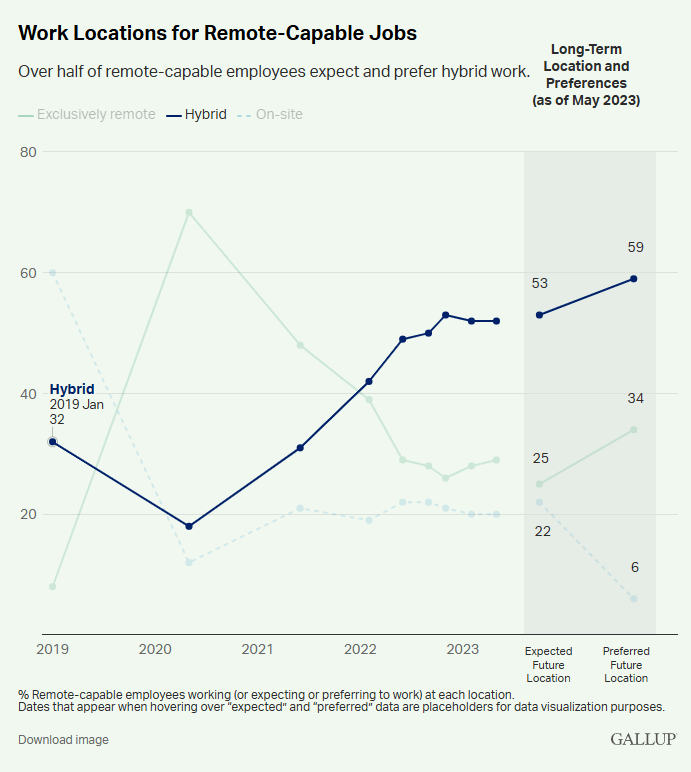
Timeline graphic showing the evolution of hybrid work from 2019 to 2023, including the rise of remote tools during COVID-19 and a long-term shift to hybrid roles among remote-capable employees.

In 2019, 32% of employees enjoyed a mix of remote and in-office work—a modest but growing shift away from traditional office-only setups. This early adoption reflected employees’ desire for remote flexibility, yet most companies continued to lean heavily towards assigned offices.

Line chart showing hybrid work rising to 59% preference by 2023, while on-site drops to 6%. Source:https://www.gallup.com/workplace/511994/future-office-arrived-hybrid.aspx
Then came COVID-19. In 2020, when lockdowns forced organizations to shut their doors, work-life changed for billions of people. Remote work surged to unprecedented levels as, suddenly, nearly every employee was working from their bedrooms and couches.
Line chart showing exclusively remote work peaking at 70% in May 2020, then declining to 25% expected and 34% preferred by 2023. Source: https://www.gallup.com/workplace/511994/future-office-arrived-hybrid.aspx

Video Conferencing platforms (Zoom, Microsoft Teams) boomed in support of this change. In fact, Zoom’s revenue shot up to $2.65 billion in 2021, up more than 300% from just $623 million in 2020, which was the last year unaffected by COVID-19.


As the immediate crisis began to ease up in 2021, companies didn’t simply tell everyone to get back in the office. Instead, many embraced the hybrid model once more, blending the freedom of remote work with the value of in-person interaction.


By 2021, the hybrid model had grown from its ~44% dip in 2020 to roughly the same popularity it had before the pandemic. And it kept growing. Office attendance also rose from its dip in 2020, but not nearly as much as hybrid work. In fact, McKinsey’s Hybrid Work report shows office attendance is still 30% lower than it was before the pandemic.

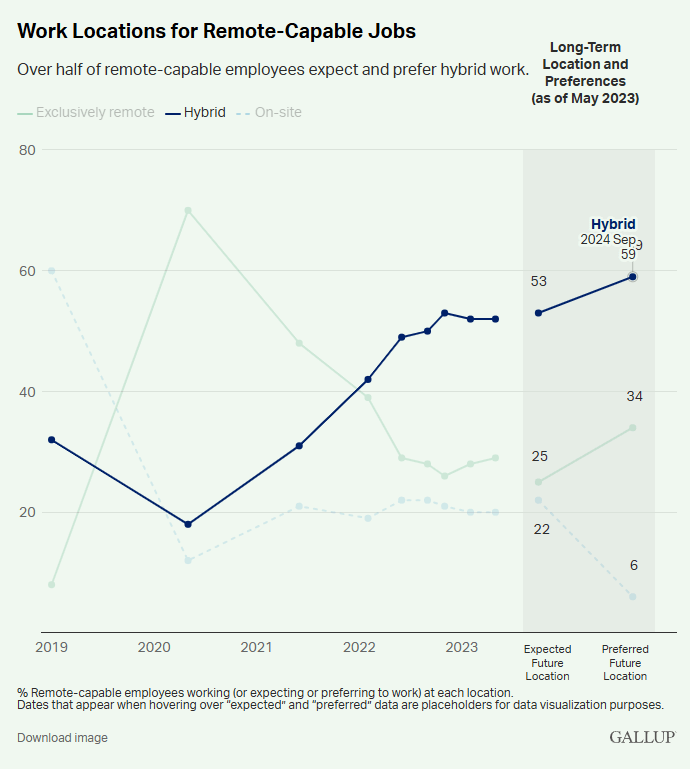
Line chart showing hybrid work rising from 2019 to 2023, with 59% of remote-capable employees preferring hybrid work by 2024. Source: https://www.gallup.com/workplace/511994/future-office-arrived-hybrid.aspx

Today, hybrid work has become a preferred working model for remote-capable employees all over the world. As of 2023, 40% of these employees had shifted from working entirely on-site to either a hybrid or exclusively remote work setup.


Gallup’s research showed that when employees work from their desired location, they tend to be more engaged at work, less burned out, and less likely to quit. That’s why:

  • Nine in 10 remote-capable employees prefer some remote work flexibility, and
  • 45% of remote-capable employees are extremely likely to leave an organization if not offered at least some degree of remote flexibility.

Leaders are also noticing this change and are keeping the hybrid work model as a long-term, if not permanent, fixture of their companies. Eight in 10 chief human resources officers (CHROs) from Fortune 500 companies told Gallup that they have no plans to decrease remote work flexibility in the next 12 months.


The rise of hybrid work is not just a significant change in workplace preferences; it also highlights a meaningful shift in how we structure and value our work in this new post-pandemic world.

Benefits of hybrid work

Hybrid work isn’t just a fad—it resonates with both employees and employers for solid reasons:


Increased flexibility

Modern workers place a high value on the freedom to decide when and where they work. With the hybrid work model, they don’t have to spend hours in traffic every day or sit in the office just for appearances. Instead, depending on their company's hybrid work model, employees can do deep-focus tasks from home and go to the office when they need to collaborate with the team.


Better work-life balance

A survey conducted by the UK Parliament showed that 78% of employees who worked from home in some capacity experienced improved work-life balance. Hybrid work helps employees reclaim the time they would otherwise spend commuting, allowing them to focus on personal responsibilities. Fewer hours in traffic or crowded trains means more freedom to plan errands, spend time with family, or simply enjoy a calmer morning routine.


Higher productivity

The second most popular answer to McKinsey’s survey asking why employees want to work from home is ‘increased productivity.’ Gallup’s research supports this sentiment, as 52% of employees find that working in a quiet home environment free from the usual office distractions helps them complete assignments more efficiently.

Bar chart comparing top 5 benefits of hybrid work for employees and organizations. Source: https://www.gallup.com/workplace/511994/future-office-arrived-hybrid.aspx

However, some assignments are more intensive than others. In-office days in the hybrid work model strike a balance by creating opportunities for real-time discussions and collaborative problem-solving.


Cost savings for both employees and businesses

Hybrid work eases financial pressure on both sides. Employees spend less on commuting and work attire, and they skip many of the costs that come with being in an office all day—like buying lunch or extra coffee runs. This way, they have more money to spend or put into an emergency fund.


On the other hand, businesses can reduce their real estate footprint, trim utility bills, and cut back on everyday office supplies like paper, stationery, and furniture. The money companies save can either go toward profit or be used to expand the business.


Higher employee satisfaction and retention

Gallup’s study showed that 50% of leaders say the hybrid work model improves employee retention.


Here’s why: Hybrid work models allow employees to craft schedules that fit their lives, which in turn makes them feel more valued and understood. When workers see that their employer trusts them in this way, they become more engaged and motivated at work.


This leads to a stronger commitment to the company, reducing turnover and building a loyal, satisfied workforce over time.


Supports sustainability goals

A study by Global Workplace Analytics found that if everyone who can work remotely did so just half the time, greenhouse gas emissions could reduce by 54 million tons annually.


Hybrid work cuts down on the need for daily commutes, lowering carbon emissions and reducing air pollution. With fewer employees traveling long distances every day, the collective environmental impact of transportation shrinks noticeably.


Also, maintaining a smaller, more efficient office space results in lower energy consumption and waste production for businesses. By embracing a hybrid model, companies can align their operations with broader sustainability goals.

The challenges of hybrid work

Despite its many advantages, hybrid work also has downsides. Here are some of them:


The myth of ‘best of both worlds’

The hybrid work model might seem like the best of both worlds, but when poorly executed, it can trap teams in the pitfalls of both extremes.


Remote employees might miss out on spontaneous interactions, which leaves them feeling isolated, and in-office days can turn into overloaded schedules with endless meetings.


This eventually leads to siloed teams, disengagement, and even logistical chaos.


The ‘proximity bias’ problem

In hybrid settings, interactions tend to happen naturally among those physically present in the assigned office—casual hallway chats, impromptu meetings, or quick clarifications over a shared workspace.


Remote team members, on the other hand, rely on scheduled calls or formal channels to communicate, which can reduce collaboration and lead to less spontaneous input.

Chart showing top hybrid work challenges, led by reduced communication and collaboration. Source: https://www.gallup.com/workplace/511994/future-office-arrived-hybrid.aspx

This imbalance can cause managers and peers to inadvertently pay more attention to those in the office while sidelining remote employees. Over time, this results in unequal access to information and collaboration, ultimately affecting teamwork and overall employee engagement.


Hybrid fatigue

Hybrid work has helped many employees prevent burnout, yet it sometimes creates new strains on them. Switching from a laid-back home setting to the dynamic pace of the office can disrupt focus and increase stress.


Also, the pressure to be constantly available —whether on a video call or in the office—can blur the boundaries between work and personal life, leading to a sense of being perpetually "on."


This constant context-switching taxes energy levels and makes it challenging to settle into a stable routine—contributing to fatigue.


Hybrid work requires continuous maintenance

Hybrid work isn’t a set-it-and-forget-it solution—it needs regular fine-tuning to keep everything running smoothly. As employee needs and business priorities change, policies and workflows that worked well in an office-only setting quickly become outdated.


For example, you’ll need to adjust meeting schedules, communication protocols, and task coordination methods to bridge the gap between remote and in-office experiences. If you weren’t using communication tools like Slack and Zoom before, you’ll need to adopt them.


Without continuous oversight—such as routine feedback sessions and policy updates—a hybrid work model can easily slide into confusion and inefficiency.


Hybrid work isn’t suitable for all industries

The hybrid model is great for industries like marketing, IT/technology, and professional services (accounting, finance, consulting) because employees don’t always have to be in the office to do their work.


However, it gets trickier in industries like healthcare, manufacturing, and construction, where some functions still rely on being onsite. For example, in healthcare, while telemedicine and remote monitoring have expanded the possibilities for hybrid care, patient treatment still often requires hands-on assessments and direct supervision.


Likewise, in manufacturing, administrative tasks or quality reviews can be done remotely, but equipment operation, safety checks, and real-time troubleshooting still call for on-site expertise.

Types of hybrid work models

Hybrid work models fall into two broad categories: autonomy-focused hybrid models and office-first hybrid models.

Autonomy-focused hybrid models

These models focus on how much control employees, teams, and managers have to design their workdays.

Employee-controlled hybrid model. Employees decide which days they come into the office.
Company scheduled hybrid model. The organization sets specific days for remote and in-office work across the workforce or for particular teams.
Manager-assigned hybrid model. Individual managers determine the in-office days for their teams based on project demands and team dynamics.
Blended hybrid model. Combines elements of employee choice, company-set schedules, and managerial guidance into a single framework.

Office-first hybrid models

These models feature the office as the primary hub for work while incorporating some remote flexibility.

Office-first, remote as a perk. The company expects employees to work mainly from the office, with occasional remote days offered as a bonus.
Office-first with remote balance. This model grants employees a high degree of remote work freedom while maintaining a solid office presence.
Remote-first with optional office use. The company operates primarily as a remote-first organization, with the office serving as a flexible resource.

Autonomy-focused hybrid models

These models focus on how much control employees, teams, and managers have to design their workdays. Autonomy-focused hybrid models come in four variations:

  • Employee-controlled hybrid model. In this model, employees decide which days they come into the office.

    For example, an employee might choose to work remotely on days when they have concentrated tasks, reserving office time for when they feel a creative spark or need to connect with colleagues face-to-face.

    Currently, 31% of employees have full autonomy to choose their own office schedule each week, while 10% are encouraged to follow specific guidelines. This approach thrives in cultures that value autonomy and self-management.
Bar and line chart showing hybrid workers are most engaged (46%) when schedules are set by their team. Source: https://www.gallup.com/workplace/511994/future-office-arrived-hybrid.aspx
  • Company scheduled hybrid model. In this model, the organization sets specific days for remote and in-office work across the workforce or particular teams.

    Employees know when they’re expected to be on-site, while managers can plan projects and workflows around this set schedule. Approximately 5 in 10 employees have a required hybrid schedule.

    This includes 28% who are required to be in the office on specific days and 22% who are required to be on-site a minimum number of days each week (but they can choose which days).

    This model works best in environments where coordinated teamwork is critical and a uniform presence can drive efficiency.

  • Manager-assigned hybrid model. This model shifts the decision-making from a company-wide policy to individual managers, who determine the in-office days for their teams based on project demands and team dynamics.

    So, the Head of the Marketing team, for example, could choose Tuesdays and Thursdays as in-office days, while the Head of the IT team could pick Mondays and Fridays. This approach recognizes that different teams may require different balances between remote and in-person work.

  • Blended hybrid model. This model combines elements of employee choice, company-set schedules, and managerial guidance into a single framework. Some teams or roles may have mandatory office days determined by the company or managers, while others enjoy the freedom to choose their own in-office time.

    While this approach is highly adaptable, there must be clear communication and guidelines to avoid confusion and ensure that all employees understand the expectations.

Office-first hybrid models

Office-first hybrid models emphasize the assigned workplace as the primary hub for work while incorporating elements of remote work to offer some flexibility. Here are its variations:

  • Office-first, remote as a perk. In this model, the company expects employees to work mainly from the office, with occasional remote days offered as a bonus.

    This means that while the office is the go-to place for discussions, brainstorming, and team-building, employees can also enjoy the flexibility of working from home when they need quiet or have personal commitments.

  • Office-first with remote balance. This model grants employees a high degree of remote work freedom while maintaining a solid office presence. Typically, workers spend 2-3 days in the office and work from home the rest of the week.

    This model ensures that all employees are present enough to participate in team activities and informal interactions while also adapting their work-life to accommodate their personal needs.

  • Remote-first with optional office use. In this setup, the company operates primarily as a remote-first organization, with the office serving as a flexible resource—a meeting spot, a creative hub, or a venue for team gatherings.

    Here, employees can choose to work from anywhere, but an office space remains available for those who prefer a change of scenery or need face-to-face collaboration. This approach ensures that while the default is remote work, the option for direct interaction is always on the table.

Rethinking hybrid work: Purpose-driven, not location-based

It’s easy to approach hybrid work as a logistical decision—how many days in the office? Which model should we pick?


But the real question isn’t about office attendance. It’s about designing hybrid work so that your employees are more fulfilled, engaged, and productive. Here are some practical steps to help you do this:


Start with the work, not the office

Before setting fixed office days, take a hard look at what your teams actually do. The goal is to align your hybrid work model with the nature of the tasks.

  • Tasks that require concentration, such as coding or writing, are often best done in a quiet, distraction-free environment.
  • Activities like brainstorming, creative problem-solving, and strategy sessions usually benefit from face-to-face interaction.

The frequency at which teams engage in these tasks should determine how many days employees spend in the office. If a team does more deep-focus work, then they can work remotely on most days. But if they do more collaborative tasks, then more in-office days may be more appropriate.


Pro tip: Align your hybrid work model to your business priorities, too. So, if you’re trying to increase employee satisfaction, you can let employees choose the days they come into the office. Similarly, if you want to reduce costs, evaluate whether fewer in-office days can help trim operational expenses without sacrificing collaboration.


Survey employees and leaders before making decisions

Gallup’s research found that hybrid workers are most engaged when their team works together to determine their hybrid schedules. Unfortunately, only 12% of hybrid employees say their team used this approach.


As a leader, you must ensure that the hybrid model you enforce meets the needs of those who will use it. So, before rolling any policy, survey both employees and managers. Their insights can help you understand who thrives in a remote setting and who benefits more from in-person collaboration.


Here are some things to keep in mind:

  • Understand work preferences and pain points. Ask employees about their ideal work environment and the challenges they face in the current setup. Their feedback can reveal whether deep-focus tasks, creative sessions, or routine meetings would benefit from being remote or in the office.

  • Recognize team variations. Different departments have different needs. For instance, product development teams might perform better with regular face-to-face interactions, while marketing teams could be more efficient working asynchronously.

  • Balance business needs with flexibility. Rigid policies can frustrate employees. So, use the survey results to strike a balance between meeting strategic business goals and accommodating employee preferences.

Redefine the office as a resource, not a mandate

The office shouldn’t just be a place employees “have to” come to —it should be a space that adds value to their work.

  • Shift away from traditional layouts filled with isolated cubicles.
  • Create spaces that encourage impromptu brainstorming sessions, cross-team interactions, focused group work, and informal networking.

The goal is to create an environment employees naturally gravitate toward because it enriches their work experience, not because the company instructs them to.


Invest in tools that support both real-time and flexible collaboration

Hybrid work only succeeds when employees have the right tools to communicate and collaborate seamlessly, wherever they may be.


Here are some tools to help bridge the gap between remote and in-office teams:

  • Flexible messaging tools. Tools like Slack and Mattermost allow teams to share updates, ask (and answer) questions, and exchange ideas at their own pace.

    Without them, communication can lag or become disjointed. This leads to missed updates and delayed decision-making, especially for teams distributed across different time zones.

  • Video conferencing platforms. Platforms like Zoom and Microsoft Teams allow employees physically located in different places to communicate and collaborate with each other. These platforms also support functions like screen sharing, breakout rooms, and integrated chat, which help create a cohesive meeting experience.

  • Video conferencing equipment. Poor audio, choppy video feeds, and unreliable connections can make hybrid meetings ineffective and tiring. So, invest in high-quality headsets like our Evolve2 series. They offer exceptional audio clarity and noise cancellation, which means conversations remain clear and free from disruptive background noise.

    Also, invest in a video-conferencing camera that captures the entire room during meetings. Our Panacast50 video bar does this well: it has three 13-megapixel cameras that provide a 180° view of the room in high-definition panoramic 4K.

    This way, no one is distorted, squeezed together, or cut out of frame.
  • Digital whiteboards. Physical whiteboards limit collaboration to those present in the room, making it hard for remote team members to participate. However, digital whiteboarding tools like Miro and PanaCast 50’s Dual-Stream Whiteboard allow both remote and in-office workers to contribute in real-time or in their own time with ideas saved and accessible to all.

  • Project management tools. Tools like Asana and Trello offer a centralized space where managers can assign, track, and update tasks in real-time, regardless of location.

    With features like task dependencies, file sharing, and integrated communication channels, these tools ensure that hybrid teams can coordinate effortlessly, maintain clarity on project status, and meet deadlines.

Focus on results, not hours

Measuring productivity by the number of hours spent in the office misses the true goal of work: achieving meaningful outcomes. In a hybrid environment, what matters is not the hours worked but how effectively goals are met.


So, instead of tracking attendance or remote working hours, measure whether your marketing campaign met its engagement targets, if your product launch generated signups, or if your customer support team reduced response times.


Shifting the focus from hours clocked to the actual impact of work encourages a results-driven culture. This not only motivates employees by recognizing their contributions but also aligns the hybrid model with your company’s broader strategic objectives.


Design hybrid principles that evolve with business needs

Hybrid work isn’t a fixed model, so create new principles—not policies—based on employee feedback, evolving business objectives, and measurable work outcomes.


For example, a rule mandating a specific number of in-office days might not serve a team that benefits more from remote deep-focus work. Similarly, fixed meeting schedules that require everyone to be present at a set time can hinder productivity if some teams thrive on asynchronous communication.


Regularly review your hybrid principles by collecting feedback, monitoring performance metrics, and observing how project outcomes align with business goals.


Strengthen company culture for hybrid success

In a hybrid work environment, a strong company culture won’t emerge on its own—you must cultivate it intentionally.


When some team members work from the office and others remotely, it's crucial to create experiences that bring teams together and break down silos. Here are some things you could try:

  • Implement cross-departmental projects or organize regular virtual coffee breaks to help build connections and spark ideas.
  • Recognize the contributions of remote employees just as enthusiastically as those on-site, using shout-outs, awards, or dedicated recognition moments during meetings.
  • Create opportunities for social engagement—whether through team-building activities, offsite retreats, or informal chat channels.

These intentional actions not only boost morale but also drive collaboration and innovation throughout the company.

Measuring success: Is your hybrid model working?

After implementing your hybrid work model, actively monitor your teams’ performance using specific metrics and key performance indicators (KPIs). This process helps you identify what’s working (and what isn’t) and provides actionable insights to adjust your policies and strategies as needed.


Here are some key metrics to track:


1. Employee engagement and satisfaction

Gauge how connected and valued your team feels by sending out regular pulse surveys using digital feedback tools like Google Forms or SurveyMonkey.


In your survey, ask questions about connectivity, job satisfaction, and overall morale. Look for trends in the responses: rising employee engagement scores are a clear signal that your teams feel connected and supported in the hybrid setup.


Pro tip: Complement these surveys with one-on-one check-ins or small group discussions to catch any concerns that surveys might miss.


2. Employee productivity

Measure productivity by tracking project completion rates, quality of deliverables, and customer feedback. Also, use project management software like Asana or Trello to monitor deadlines and task progress in real time.


Then, compare the data from before and after you rolled out your hybrid model to see if there’s an improvement. You can also set up a simple dashboard that visually represents progress to help you quickly spot trends in efficiency and output.


3. Collaboration frequency and effectiveness

Assess how well your teams collaborate by tracking how often they come together—virtually and in person—and the outcomes of these interactions.


Tools like Microsoft Teams or Zoom offer analytics on meeting participation and duration, including who attended, when they joined, and how long they were in the meeting. These details help you see if the balance of remote and in-office interactions is driving teamwork and problem-solving.


4. Employee retention and turnover

Use HR software like BambooHR and Lattice to track employee turnover trends over time and compare them against the timeline of your hybrid implementation.


If more employees are resigning after your implementation, then there might be something wrong with the model. But if your employees stay longer on average after implementation, then you’re doing something right.


Pro tip: Conduct exit interviews whenever employees resign from your company. This allows you to learn directly from them why they’re leaving and if it has anything to do with your hybrid model.


5. Cost-efficiency

Finally, evaluate the financial benefits of your hybrid model by comparing savings on office space, utilities, and commuting expenses against gains in productivity and output.


Use a simple Excel spreadsheet or budgeting software (e.g., QuickBooks, Xero) to track changes in operational costs before and after you introduce your hybrid model. When you see tangible cost savings alongside improved performance, then your hybrid model is likely working.

Hybrid work is about flexibility, not compromise

Most employees prefer the hybrid work model because of the freedom and autonomy it offers. When building your hybrid model, focus on aligning work environments with the specific needs of each task rather than simply tracking office days. Talk with your employees and managers to create policies based on real feedback and project outcomes.


Since meetings play a major role in hybrid work, having the right tools makes all the difference. A video bar with a wide field of view ensures that remote participants feel just as present as those in the room, while noise-canceling headsets eliminate background noise for clearer conversations.


For example, the Panacast50 video bar uses multiple cameras and real-time stitching to deliver an immersive 180° view, so all participants are seen clearly. And our Evolve2 headsets offer rock-solid connectivity and advanced noise cancellation, ensuring every word comes through without audio interference.


By focusing on the work, engaging your team, and providing the right tools, you can build a hybrid work model that adapts to your workforce's diverse needs and drives lasting success.