The state of meetings in hybrid work

How can we make hybrid meetings better?
For years now, hybrid work has increasingly become the new normal for millions of knowledge workers around the world.
Of course, this work revolution has also brought with it new challenges. While employees embrace the well-being benefits of flexible work, many leaders and managers have struggled to lead distributed teams.
Similarly, with challenging macro-economic circumstances characterized by fears of a decline in employee productivity, many leaders have mandated a return to the office, oftentimes despite the wishes of their employees.
But perhaps more than anything, the way we collaborate with one another has been challenged through an increase in online and hybrid meetings. In our latest Hybrid Ways of Working research, we’ve surveyed employees in six key markets around the world to focus on the state of meetings and uncover the largest barriers and opportunities for employees and organizations.
Key Findings
Employees are spending more time in the office as the return-to-office (RTO) intensifies
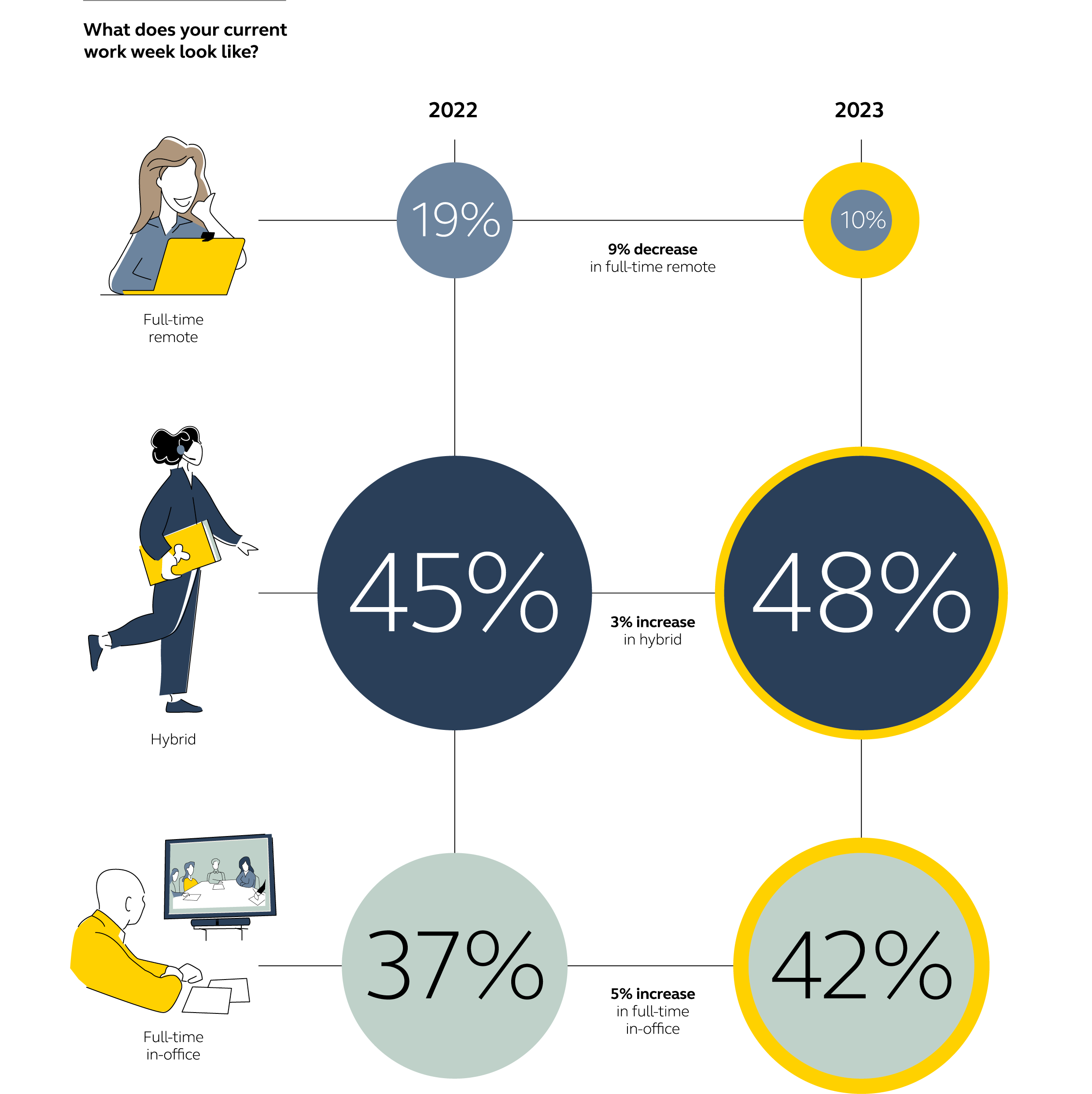
For the past three years, employees’ work experience has largely been defined by more time in remote and home working locations. And while these still play a role in the future of work, our latest data shows that many workers are once again returning to the office.
This is seen through an increase in employees working in both hybrid and full-time office modes, as well as a decrease in full-time remote work.

Gen Z and Millennials are still feeling left out in online meetings
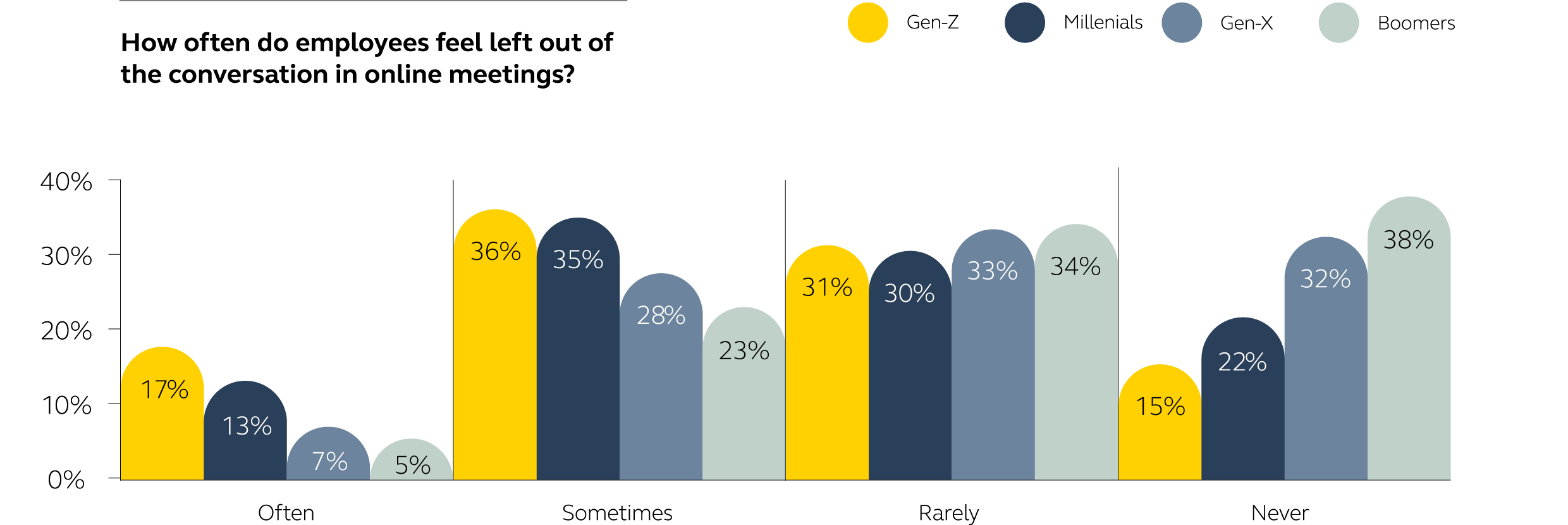
One of the most prominent drivers of inclusion (or exclusion) we found in our data is age. When we asked employees how often they feel left out of the conversation in online meetings, we found stark differences along generational lines.
Gen Z and Millennials were 2-3x as likely as Gen X and Boomers to say they often felt left out in online meetings. Similarly, Gen X and Boomers were roughly 2x as likely to say they never feel left out.

Using video can have a positive and empowering impact on your career
Should you have cameras on or off in an online meeting? For years, teams have been debating this exact question.
Many who want cameras on claim that it boosts communication through better understanding of facial expressions and body language, while many who prefer cameras off find that thinking about how they’re seen on camera distracts them from actually focusing on the work.

Employees aren’t yet comfortable with meeting room technology. It’s time to help them.

Many employees still have limited access to video-equipped meeting rooms
While we’ve seen that many employees are hesitant to take meetings from meeting rooms because they’re not comfortable with the technology, many more simply don’t have the option.
Only 15% of employees say that all of their office’s meeting rooms are equipped with video cameras for online meetings. This translates to roughly 100 million meeting rooms around the world waiting to be optimized for hybrid work. Access to video-equipped meeting rooms is one of largest barriers that employees are currently experiencing in their return to the office.
The Next Steps:
Meetings have seen a tumultuous few years. With the rise of remote and hybrid work, we’ve continually encountered new challenges, and one by one, we’ve adapted and come back stronger than before. And now is no different. There are still major challenges to overcome in our path to inclusive and productive work, but technology and knowledge keep evolving to meet the moment.
When people are confident on video, they’re able to show their most professional self. This can have major career benefits for employees, as they’re able to create an impression of engagement and confidence while collaborating. However, if colleagues have their video off, we shouldn’t be so quick to judge; many feel pressured to turn cameras on while others are fine leaving them off. This is oftentimes driven by who is in the meeting or what their role is within it. Instead, we must take note of these social dynamics and allow everyone to join in a way that works best for them.
We’ve gotten better at hybrid work, but that doesn’t mean that all the challenges are behind us. Moving forward, leaders must take a critical look at what’s hindering their employees’ meeting experiences and unlock the next wave of inclusive and productive collaboration.
Methodology:
Download the full report